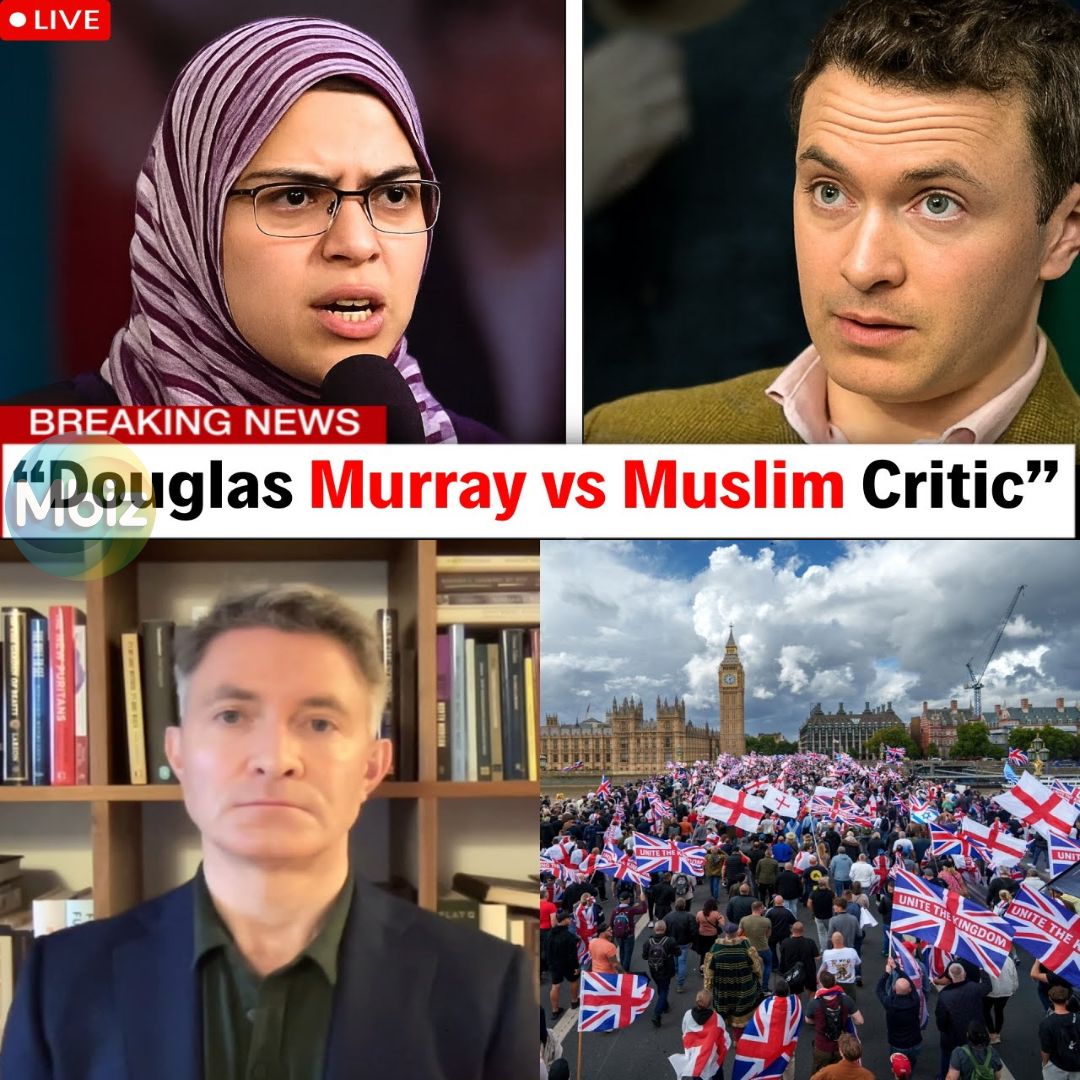
In a tense and explosive debate that has left audiences stunned, Douglas Murray delivered a resounding rebuke to a young British Muslim woman who accused him of racism. The confrontation, charged with heightened emotions and rapid-fire exchanges, unfolded in front of a packed hall, exposing deep societal rifts and the volatile nature of discussions around Islam and integration in Europe.
 The ordeal began with the young Muslim speaker stepping forward, confidently labeling Murray a racist. She challenged him directly, claiming British Muslims are unfairly singled out as problems rather than embraced as equals. Her voice resonated with personal pain as she recounted experiences of racism, including violent assaults and discrimination suffered simply for wearing a scarf.
Murray, however, refused to be derailed. He responded with a laser-focused clarity that cut through the accusations, insisting that legitimate criticism of Islamic ideologies and certain attitudes within Muslim communities must not be silenced under the guise of racism. Each attempt by the Muslim woman to frame Murray as alienating Muslims in Europe was met with unyielding logic and calm rebuttals.
The debate took a sharper turn when Murray confronted the audience with uncomfortable facts, referencing terrorism and events such as 9/11. His assertion that Islam is associated with violence ignited outrage, with boos erupting immediately. Yet Murray stood firm, citing historical realities and the challenges of integrating a rapidly growing Muslim population across Europe.
He highlighted the staggering demographic shifts that European societies have faced, noting the jump from negligible Muslim presence mid-20th century to at least 15 to 17 million Muslims in Western Europe today. This rapid migration, he argued, poses unprecedented challenges that no society would manage without friction.

Murray pressed further, addressing the intolerance prevalent in many Islamic societies—towards apostasy, freedom of speech, and minority rights—issues now spilling over into Western democracies, especially Britain. His warnings about calls for parallel legal systems fueled the tension, underscoring a fundamental clash between secular European law and religious doctrine based on revelation.
The audience’s restless murmurs and bursts of boos only seemed to sharpen Murray’s resolve. He insisted that European societies have extended rights and freedoms to Muslims far beyond what is allowed in many Islamic nations but warned that these freedoms come with responsibilities. The impassioned speech struck a raw nerve, as attendees grappled with uncomfortable truths about multiculturalism’s limits and the demands of integration.
When the young Muslim woman challenged his comments with personal anecdotes, asking if Murray would be comfortable if his own child converted to Islam, the debate escalated into a deeply personal and emotional exchange. Yet amidst the turmoil, Murray maintained his composure, underscoring a critical distinction between prejudice and necessary critique—an argument few in the room were prepared to confront so directly.

The tension peaked as other speakers attempted to derail the narrative, with one vehemently rejecting Murray’s association of Islamic terrorism with Muslim communities. A controversial retort involving historical references to the Holocaust and questioning Muslim involvement instantly ignited further controversy, met with stern corrections from Murray citing documented alliances during World War II.
A subsequent claim by another Muslim participant that Islam empowers women was swiftly countered by Murray, who delivered a stark assessment: what was once progressive in seventh century Arabia is no longer progressive in modern Britain. The room fell silent, silenced by the unassailable power of his factual rebuttal.
Throughout the fiery debate, Murray repeatedly condemned the presence of hatred preached in some Islamic institutions within the UK. He spotlighted disturbing reports of calls for violence against minorities and apostates on university campuses, stressing that such bigotry must never be tolerated, regardless of religious context.

This explosive confrontation encapsulates the turbulent and deeply complex dialogue surrounding Islam in Europe, freedom of expression, and societal cohesion. Murray’s unwavering stance—asserting the right to criticize ideologies without being branded racist—has ignited a firestorm of reactions, with the debate far from settled.
As tensions simmer in this charged atmosphere, the wider public and policymakers are forced to face the challenging questions: How do we reconcile freedom of speech with respect for diverse communities? Can integration succeed without confronting uncomfortable cultural truths? And what does the future hold for Europe’s Muslim population?
This dramatic episode serves as a stark reminder that ongoing dialogue about identity, religion, and values in modern Europe is fraught with difficulty but necessary. The sparks ignited in this hall will undoubtedly reverberate far beyond, fueling debates on integration, multiculturalism, and the very fabric of European society for years to come.